

Flag Patches: What You Need to Know
Quick Answer
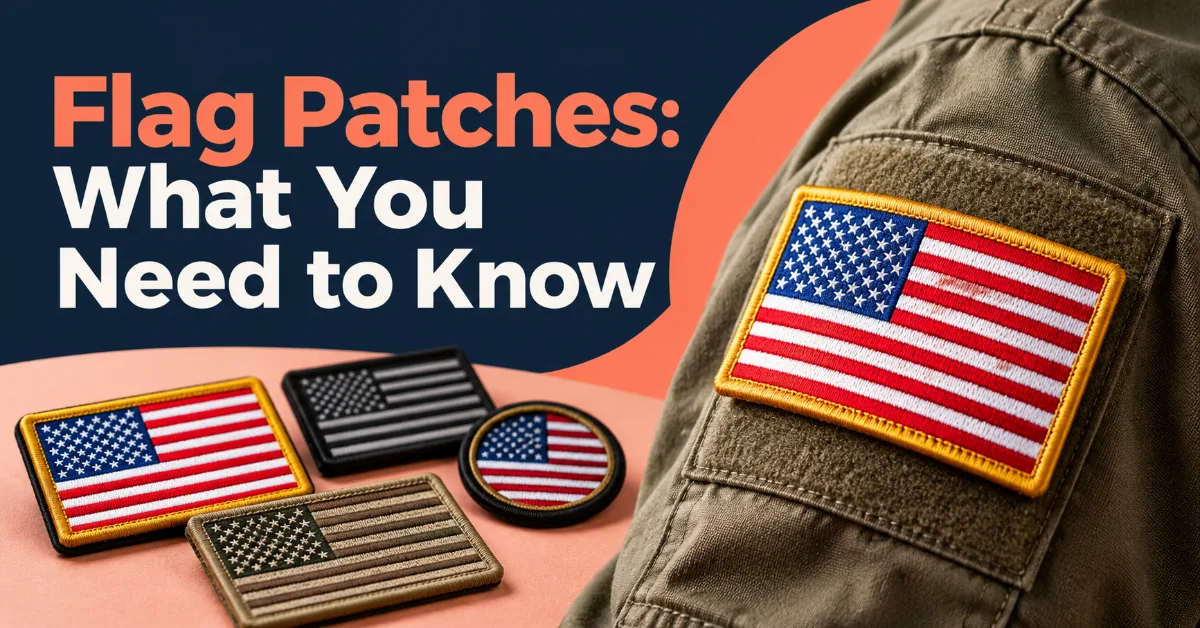
A flag patch is a small fabric or rubber copy of a flag that you sew, iron, or stick onto clothing and gear. The U.S. Flag Code allows flag patches on the uniforms of military members, firefighters, police officers, and patriotic organizations. On Army uniforms, the patch on the right shoulder is reversed so the stars face forward. If your business needs flag patches for uniforms, teams, or gear, Emboro Stitch can make them in six patch styles, starting at 10 pieces per design.
This guide covers the rules, the main patch types, and the steps to order flag patches without costly mistakes.
What Is a Flag Patch and Who Uses Them?
A flag patch is a badge that shows a flag design. It can be stitched, woven, molded from rubber, or printed. The design is most often the U.S. flag, a state flag, or a country flag.
Businesses and groups usually order flag patches for three reasons:
- Uniforms. A flag on the sleeve or chest is part of the look for clubs, schools, work crews, and other uniformed groups.
- Teams and organizations. Sports teams, school programs, and clubs use them to show pride and to match every member.
- Gear and branded products. Caps, bags, jackets, vests, and tactical gear are common places for a flag patch.
A flag patch is not the same as a logo patch. The flag has its own rules for how it can be worn, and some of them affect how you design and order the patch. The next sections cover those rules first, then the ordering choices.
What the U.S. Flag Code Says About Flag Patches
The U.S. Flag Code (4 U.S.C. §§ 5 to 10) is a set of customs for how to display and respect the flag. The section that matters for patches is 4 U.S.C. § 8, and four parts are useful to know:
- § 8(j), uniforms. No part of the flag should be used as a costume or athletic uniform. The exception is that a flag patch may be attached to the uniform of military personnel, firefighters, police officers, and members of patriotic organizations.
- § 8(d), clothing. The flag itself should not be used as wearing apparel. A patch is a small replica, and the exception in § 8(j) covers patches on the uniforms named above.
- § 8(g), marks on the flag. Nothing such as a letter, word, or picture should be placed on the flag. A safe design choice is to keep the flag clean and put any name or logo next to it, not on top of it.
- § 8(i), throwaway items. The flag should not appear on items made for temporary use and discard. Think of flag patches as a lasting item, not a one-time giveaway.
Is the Flag Code a law you can be penalized for? The Congressional Research Service says the Code has no enforcement provisions and sets no penalties. Courts have called it advisory, and it is written as a guide for civilians. You can read this in the CRS report on federal flag law. State rules can differ, so check with a lawyer if you are building a large uniform program. This guide is not legal advice.
What this means when you order:
- Uniform use by the groups named in § 8(j) is directly covered by the Code.
- For other businesses and clubs, flag patches on clothing are common, and the Code does not set penalties for them.
- Section 8 does not say where on a garment a patch must go. Placement rules come from the uniform policy of the organization, as the next sections show.
Why the Flag Looks Backward on the Right Sleeve
The U.S. Army wears a “reverse” flag on the right shoulder so the star field faces forward. This makes the flag look like it is flying ahead as the wearer moves. It is on purpose, not a mistake.
The Army’s own guidance says the flag is worn with the star field facing forward, or to the flag’s own right, and that the right shoulder uses the reverse side flag (Army Uniforms and Grooming Guide; DA PAM 670-1, section 21-19, summarized on AR670.com). In 2004, an Army spokesman told Stars and Stripes the idea comes from early battles, when a standard bearer carried the flag forward and it streamed back behind him (Stars and Stripes).
The logic is easy to check. A person faces forward, so the right sleeve is seen from the right side, where the front of the body is on the viewer’s right. A standard flag has its stars on the viewer’s left, so it would point backward. The reverse version fixes that. On the left sleeve, the standard flag already points forward.
The Army does not sew this patch on utility uniforms. It is worn on a hook-and-loop pad, so flag patches made in this style use hook-and-loop backing.
Myths vs. What We Could Verify
| What you may hear | What we could verify |
|---|---|
| A reversed flag is a distress signal. | No. The Flag Code ties distress to a flag shown with the union down (§ 8(a)). A reverse patch keeps the stars forward and is not upside down. |
| The reversed patch is a printing mistake. | No. Army guidance calls for the reverse side flag on the right shoulder. |
| Only soldiers can wear a flag patch. | The Code names military, fire, police, and patriotic organization uniforms, but it has no penalties for civilians. |
| Paratroopers or the Civil War started the reversed patch. | Some retailers say so, but we found no Army source. The history the Army gave is the standard bearer story, so we left the other claims out. |
Where to Place a Flag Patch
The Flag Code does not say where a patch must go on a garment, so your own uniform policy sets the rule. These are the common choices, based on Army practice and general guidance from patch sellers.
| Where it goes | Version to order | Note |
|---|---|---|
| Right sleeve or shoulder | Reverse flag | The Army wears it here with the stars forward, on a hook-and-loop pad. |
| Left sleeve | Standard flag | The stars already face forward. |
| Chest | Standard flag | Keep it centered or on the left chest, upright and straight, not tilted. |
| Cap or hat | Standard flag | Place it so the stars face the front. |
| Back of a jacket or vest | Standard flag | Center it and keep it upright. |
Sources for the civilian rows: Dutch Label Shop and Gettysburg Flag Works.
If your uniform has a flag on each sleeve, order both versions, a standard flag for the left and a reverse flag for the right. Ask your supplier how pairs count toward the minimum order.
What to avoid:
- Upside down. The Flag Code reserves a union-down flag for dire distress (§ 8(a)).
- Below the waist. Avoid shoes and the seat of pants.
- Disposable items. The Code says the flag should not be used on items made for temporary use and discard (§ 8(i)).
- Covered or crowded. Do not stack other patches over the flag or squeeze it between other graphics.
- Text on the flag. Keep names and logos beside the flag, not on it (§ 8(g)).
Types of Flag Patches
Six patch styles can carry a flag design. The best one depends on where the patch will be worn and how much detail the flag needs. The prices below are Emboro Stitch starting prices for a 3-inch patch at 100 pieces.
| Style | Look and feel | Good fit for | Price per patch at 100 pieces |
|---|---|---|---|
| Embroidered | Thread stitched on twill, raised and textured | Uniforms and caps | $2.55 |
| Woven | Finer thread, tighter weave, flatter surface | Small flags and fine detail | $2.49 |
| PVC rubber | Molded rubber, raised 3D, waterproof | Rain, sweat, mud, outdoor and tactical gear | $3.05 |
| Printed and sublimated | Full color with gradients | Waving or shaded flag artwork | $2.86 |
| Chenille | Soft, thick, raised | Large flags on varsity-style jackets | $3.75 |
| Leather | Debossed or printed leather | Jackets, vests, and bags | $4.45 |
These are starting prices. The final cost depends on size, stitch count, and finish, and you see it on the mockup before you pay. Size is priced by adding the width and height, dividing by two, and rounding up to the next size. A 2 by 3 inch flag works out to 2.5, so it is priced at the 3-inch size. Source: Emboro Stitch custom patch pricing.
Emboro Stitch makes all six styles in-house, and every order starts with a free digital mockup. Send your flag artwork, approve the mockup, and then production begins. For a deeper look at three of these styles, read our guide to woven vs. chenille vs. leather patches.
Full-Color, Subdued, and Border Choices
Full-color patches use the red, white, and blue of the flag. They suit everyday uniforms, teams, and branded apparel.
Subdued patches use muted tones instead. The Army’s tactical flag is green and black, and it is worn only when a commander directs it for field conditions (DA PAM 670-1, section 21-19, via AR670.com). Pick subdued if your gear is tactical or outdoor and you want a muted look.
IR (infrared) patches are a specialist item. They reflect infrared light so that night vision equipment can pick them out, and they are used for military identification (Wikipedia). If you need these, ask your supplier before you order, because they use special materials.
Borders finish the edge of the patch:
- Merrowed border. A dense, looped stitch wraps the edge. It gives a smooth, rounded finish, stops fraying, and works best on simple shapes (Super Label Store). A flag is a simple rectangle, so this is a natural fit.
- Hot-cut (heat-cut) border. The edge is sealed with heat or a laser as it is cut. It follows the outline closely, so it suits detailed shapes (Super Label Store).
Ask which borders are available for your patch style. For example, Emboro Stitch PVC rubber patches come with a merrowed or hot-cut edge.
Choosing the Right Backing
The backing decides how the patch attaches, and whether it can come off later. Pick it by how the garment will be worn and washed.
| Backing | Best for | Keep in mind |
|---|---|---|
| Sew-on | Daily-wear uniforms, jackets, and team runs | Most durable, but it is permanent. Included with Emboro Stitch patches. |
| Iron-on | Quick jobs, events, and light wear | Heat-activated and fast, but it is a weaker hold for items that see heavy wear. Included with Emboro Stitch patches. |
| Hook-and-loop (Velcro) | Army-style uniforms, tactical gear, and patches you want to swap | The only option that lets you remove the patch later. It costs more and needs a matching piece on the garment. Add-on at Emboro Stitch. |
| Peel-and-stick adhesive | Short-term use | Not meant for long wear. |
For caps, the guidance is similar: iron-on suits one-time events, sew-on holds up through washing and daily use, and hook-and-loop is the choice when the patch must come off (Custom Patches for Hats).
A simple rule works for most buyers. Use sew-on for staff uniforms that you do not plan to change, and use hook-and-loop when members rotate between uniforms or the patch must follow Army-style practice.
How to Order Flag Patches for Your Business
Use this checklist before you send an order. It takes five minutes and prevents most reorders.
- Choose the version. Order a standard flag for the left sleeve, chest, cap, or back. Order a reverse flag for the right sleeve. If you need both sleeves, order both.
- Pick the style. Use the table above to match embroidered, woven, PVC, printed, chenille, or leather to the garment and the weather it will face.
- Set the size. The Army flag is about 2 by 3 inches. For hats, most patches are 2 to 3.5 inches wide, and anything under 2 inches loses fine detail (Custom Patches for Hats).
- Choose full-color or subdued. If you need exact red and blue to match a uniform program, send Pantone codes, hex values, or a physical sample.
- Choose the backing. Sew-on for permanent uniforms, hook-and-loop for patches that must come off.
- Prepare the artwork. Emboro Stitch accepts JPG, PNG, PDF, AI, EPS, PSD, SVG, and even phone photos. If you only have a low-quality image, our vector art service can clean it up.
- Decide the quantity. The minimum is 10 pieces per design. The price drops fast with volume: a 3-inch embroidered patch costs $14.00 each at 10 pieces and $2.55 each at 100 pieces.
- Check the mockup. Confirm that the stars face forward, the colors are right, and no text sits on the flag. Production starts after you approve the mockup and pay the invoice.
Timing. Standard production takes 7 to 14 business days after approval. Rush production takes 3 to 5 business days for a fee. From approval to delivery, plan on 2 to 4 weeks. Emboro Stitch ships tracked to all 50 states.
Mistakes to avoid:
- Ordering one version for both sleeves, so one flag points backward.
- Approving the mockup without checking the star direction.
- Placing a logo or name over the flag.
- Choosing iron-on backing for a uniform that is washed often.
- Ordering a very small patch with fine detail.
If you want a second pair of eyes on your design, Emboro Stitch will build a free digital mockup from your artwork, with minor revisions included, before you pay for production.
Flag Patch Questions People Ask
Can civilians wear an American flag patch?
Yes. The Flag Code names military, firefighter, police, and patriotic organization uniforms, but the Congressional Research Service says the Code has no penalties and acts as a guide for civilians. Wear the patch above the waist, upright, and not on throwaway items. The Code does not mention reverse patches, so the same advice applies to them.
Is it against the Flag Code to wear a flag patch?
No. Section 8(d) says the flag should not be used as clothing, and section 8(j) makes an exception for a flag patch on certain uniforms. The Code has no enforcement provisions, so it works as guidance, not a rule with penalties.
Which sleeve does the American flag patch go on?
On Army uniforms, it goes on the right shoulder as a reverse flag. A standard flag goes on the left sleeve, chest, or cap. For other uniforms, your organization sets the rule, and the stars should always face forward.
Why is the American flag patch backwards on military uniforms?
It is reversed on the right shoulder so the stars face forward and the flag looks like it is flying ahead as the soldier moves.
Does a backwards flag patch mean distress?
No. The Flag Code reserves the union-down position for dire distress. A reverse patch is not upside down, and its stars face forward.
What is the difference between a flag patch and a flag pin?
A patch is sewn, ironed, or attached with hook-and-loop to a uniform or gear. A lapel pin is a replica worn on the left lapel near the heart, according to section 8(j).
How much do custom flag patches cost?
It depends on style, size, and quantity. At Emboro Stitch, a 3-inch patch at 100 pieces starts at $2.49 for woven, $2.55 for embroidered, $2.86 for printed and sublimated, and $3.05 for PVC rubber. See the full price table.
What is the minimum order for custom flag patches?
Emboro Stitch starts at 10 pieces per design, with price breaks at 25, 50, 100, 250, 500, and 1,000 pieces. Read more in our guide to low minimum custom patches.
Get Your Flag Patches Made
A flag patch looks simple, but the right version, style, and backing decide whether your uniforms look clean or need a reorder. Emboro Stitch makes custom patches in embroidered, woven, PVC rubber, printed, chenille, and leather styles, starting at 10 pieces per design. Wholesale pricing applies from your first order, and every order ships tracked to all 50 states.
Send your flag artwork, tell us where the patch will be worn, and we will return a free digital mockup so you can check the star direction, colors, and size before production starts.
Request a free flag patch mockup or see custom patch pricing.
Need Custom Patches?
Send us your design and get honest pricing back within 24 hours, plus a free digital mockup before production. No obligation.
Get a Quote