
Key takeaways
- Sew-on is the most permanent backing and works on almost any fabric, including leather and nylon.
- Iron-on is the fastest to apply, but it only bonds well to heat-tolerant fabrics like cotton, denim and twill.
- Velcro (hook-and-loop) is the only backing that lets you remove and swap patches in seconds.
- Avoid iron-on for leather, nylon, rainwear and other heat-sensitive fabrics. Sew those instead.
- For garments that get washed a lot, iron-on plus a few stitches gives you the clean look and the hold.
Quick answer: If you are asking about iron on vs sew on patches, choose sew-on when the patch needs to last on a jacket, vest, uniform or leather. Choose iron-on for quick application on cotton, denim and twill. Choose Velcro (hook-and-loop) when you need to remove or swap patches, as on tactical gear and team uniforms.
How much will your patches cost? Pick size, quantity and backing for an instant estimate.
Estimate your pricePatch backing types explained
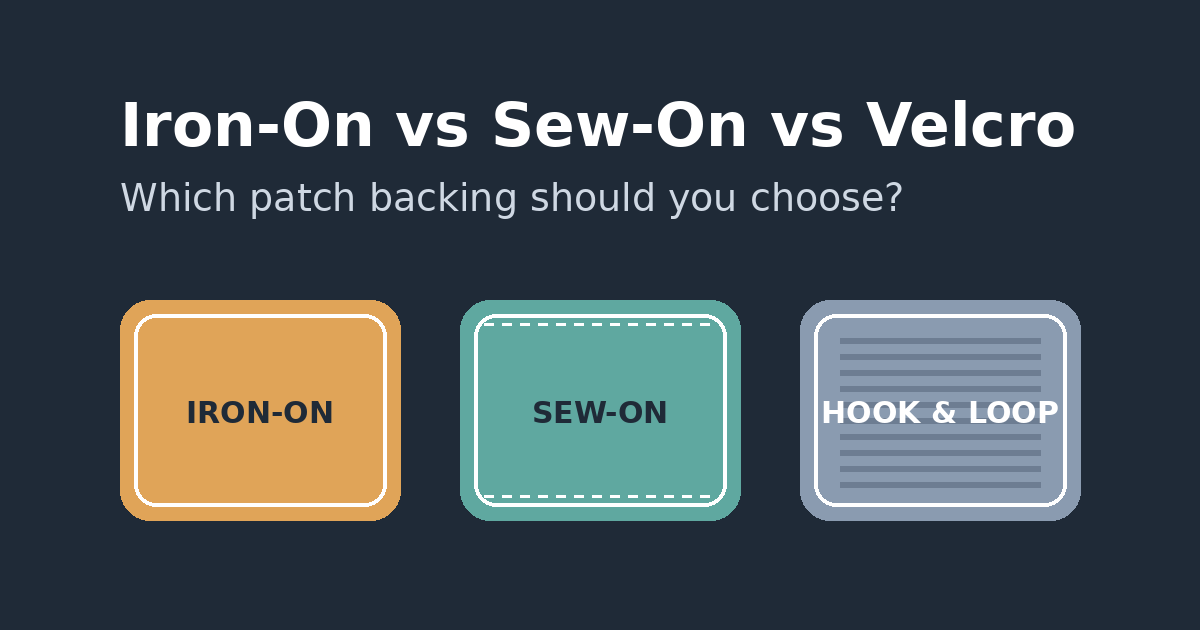
The backing is the layer on the back of a patch that decides how it attaches to the garment. The front design can be identical across all three. What changes is how long it stays on, whether you can take it off, and what fabrics it works with.
Iron-on (heat-seal) backing
An iron-on patch has a thin layer of heat-activated adhesive on the back. You press it with a household iron or a heat press, the adhesive melts into the fabric, and it bonds as it cools.
Pros: fast, no sewing skills needed, clean look with no visible stitches, good for large batches applied with a heat press.
Cons: it only works on fabrics that can take the heat, and the bond can loosen over time with frequent washing and hot drying.
Best fabrics: cotton, cotton blends, denim, twill and canvas. Cotton, cotton blends, velour, denim and wool usually take an iron-on patch well; avoid ironing patches onto waterproof rainwear, rayon, nylon, velvet, acrylic, leather, vinyl or fabrics with finishes, elastics or heat sensitivity.
How to apply: use a firm, flat surface, no steam, and a thin cloth between the iron and the patch. Press firmly instead of sliding the iron. Let it cool fully before you move or test it. If you are unsure about a fabric, test heat on a hidden seam or hem first. Adhesive maker Therm O Web gives the same advice for its HeatnBond iron-on adhesives: pre-wash without fabric softener, pretest on your material, use no steam, and allow extra press time on thicker fabrics (Therm O Web HeatnBond UltraHold directions).
Sew-on backing
A sew-on patch has a plain fabric back with no adhesive. You stitch it around the border by hand or with a sewing machine.
Pros: the most permanent option, works on nearly any fabric (leather, nylon, polyester, wool), and survives heavy wear and washing. If a stitch breaks, you can simply re-stitch it.
Cons: it takes more time to apply, and on leather the needle holes stay if you ever remove the patch, so position it once.
Best fabrics: everything, and especially leather, nylon, stretch knits and garments that get washed often.
Velcro (hook-and-loop) backing
“Velcro” is a brand name that most people use for hook-and-loop fasteners. The patch gets the hook side on its back, and the loop side is sewn onto the garment, bag or gear. The patch then presses on and peels off.
Pros: removable and swappable, so one jacket or plate carrier can carry different name tapes, unit patches or morale patches.
Cons: the loop panel still needs to be sewn on (or already be on the gear), it adds a little thickness, and the hook side can snag knits if it is left uncovered.
Best fabrics: tactical gear, backpacks, uniforms that already have loop panels, and any item where patches change often.
Peel-and-stick adhesive backing
Some patches come with a pressure-sensitive sticker backing. It is useful for one-day events, trade shows or temporary name badges, but it is not meant to survive washing. Treat it as a short-term option or a positioning aid before sewing.
Ordering patches for cotton tees, denim jackets or school spirit wear? Our custom iron-on patches come with heat-seal backing included in the price, and you see a free digital mockup before production.
Iron-on vs sew-on vs Velcro: comparison table
| Backing | Durability | Removable? | Best for | Fabrics to avoid | Application effort |
|---|---|---|---|---|---|
| Iron-on | Good on cotton and denim; can loosen with heavy washing | No (not cleanly) | Tees, denim, twill caps, spirit wear | Leather, nylon, rayon, rainwear, vinyl, heat-sensitive fabrics | Low: iron or heat press |
| Sew-on | Highest; the stitch holds even if the patch flexes | Only by cutting stitches | Leather vests, uniforms, workwear, kids’ gear | None in general | Medium to high: hand or machine sewing |
| Velcro (hook-and-loop) | High, as long as the loop panel is sewn on well | Yes, in seconds | Tactical gear, bags, swappable name tapes | Delicate knits (the hook side can snag) | Medium: loop panel sewn once, then press on |
| Peel-and-stick | Low; temporary | Yes | Events, trade shows, test placement | Anything that gets washed | Very low |
Durability and washing
How long a patch lasts depends on the backing, the fabric and how you wash it.
- Iron-on: turn the garment inside out and skip hot water and hot drying. Hot water and heat drying can loosen an iron-on patch, and sewing is recommended for a permanent hold. Therm O Web’s care guidance for its iron-on adhesive is similar: machine wash warm, dry on low or no heat, follow the garment’s care label, and avoid ironing the area over and over (source).
- Sew-on: wash it the way the garment’s care label says. The stitching does the holding, so washing affects it far less than it affects adhesive.
- Velcro: remove the patch before washing when you can, and close or cover the hook side so it does not grab other clothes.
- Loose iron-on corner? Re-press it with a cloth on top. If it keeps lifting, add a few stitches around the border.
A practical tip from production: for uniforms and workwear that go through the wash every week, we often suggest iron-on backing so the patch is easy to position, then a line of stitching around the border for long-term hold.
Which patch backing is best for your use case?

Biker vests and leather jackets
Choose sew-on. Heat can mark and dry out leather, and iron-on adhesive does not grip it well. Club back patches and rockers are almost always sewn, often by a leather shop with a heavy-duty machine.
Hats and caps
Choose sew-on for most hats. Iron-on can work on cotton twill caps if you can press the curved front evenly, but structured, foam or polyester caps do better with stitching. Read more in our guide to custom patches for hats.
Work and school uniforms
Choose sew-on, or iron-on plus stitching. Uniforms get washed often and need to look the same for months. If your uniform shirts are polyester or a performance blend, skip heat and sew.
Tactical, military-style and first responder gear
Choose Velcro (hook-and-loop). Most plate carriers, packs and tactical jackets already have loop panels, so name tapes, flags and unit patches can be swapped as needed.
Kids, scouts and youth teams
Choose sew-on for badges that need to stay; iron-on for quick fixes. Kids’ clothes get washed often, so stitching lasts longer. Many parents iron the patch on first to hold it in place and then add a few stitches.
Fashion, merch and streetwear
Choose iron-on for cotton tees, hoodies and denim, especially if you are applying patches in-house with a heat press. For premium pieces, or anything nylon, add stitching or go sew-on.
| Use case | Recommended backing |
|---|---|
| Biker vest / leather jacket | Sew-on |
| Hats and caps | Sew-on (iron-on on cotton twill caps) |
| Work and school uniforms | Sew-on, or iron-on + stitching |
| Tactical / plate carriers / packs | Velcro (hook-and-loop) |
| Kids and scouts | Sew-on (iron-on for quick fixes) |
| Fashion / streetwear (cotton, denim) | Iron-on, stitched for heavy wash |
| Nylon bags, rainwear, fleece | Sew-on or Velcro |
| Patches you swap often | Velcro (hook-and-loop) |
Need patches that come off and go back on? See our custom Velcro patches for tactical and team gear, or our custom sew-on patches for leather and uniforms. Sew-on and iron-on backings are included in the price; Velcro is a paid add-on. You can compare options on our custom patches pricing page.
Not sure which backing fits your order?
Send us your design and tell us where the patch is going. We will suggest a backing and send a free digital mockup before production, with minor revisions included. Orders start at 10 pieces.
Get a free digital mockupFAQ
Are iron-on patches as strong as sew-on patches?
Not usually. On cotton and denim an iron-on patch holds well, but sewing is the more permanent attachment, especially for items that are washed often.
Can I iron a patch onto leather or nylon?
It is not recommended. Heat can damage leather and nylon, and the adhesive does not bond reliably. Sew the patch on or use hook-and-loop.
Can I sew on an iron-on patch?
Yes. Iron-on patches can still be stitched around the border, and many people do both for extra hold.
Velcro vs iron-on patches: which is better?
It depends on whether you need to remove the patch. Velcro is better for swappable patches and tactical gear. Iron-on is better for a permanent, low-effort patch on cotton or denim.
How do I wash clothes with iron-on patches?
Turn the garment inside out, avoid hot water and high dryer heat, and follow the garment’s care label.
Which patch backing costs more?
At Emboro Stitch, sew-on and iron-on backings are included in the price. Velcro and other backings are paid add-ons. Use our price calculator for an estimate.